

Å skape fremragende programvare
La oss bygge noe ekstraordinært sammen.
Stol på Lasting Dynamics for enestående programvarekvalitet.
Michele Cimmino
feb 27, 2026 • 8 min read
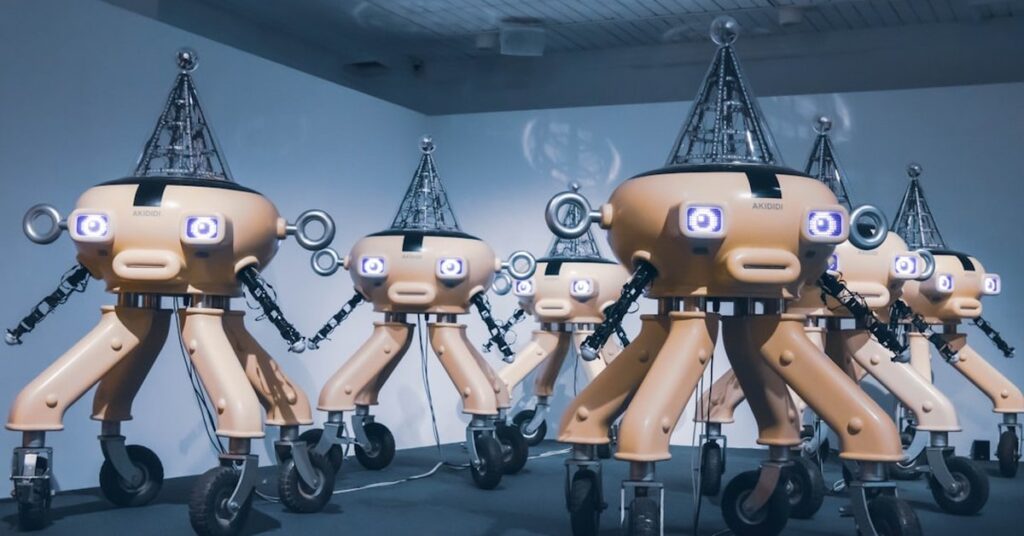
Sixty percent of warehouses are increasing their automation budgets by twenty percent this year, according to Sellers Commerce's 2026 warehouse automation statistics report. Investors poured $6 billion into robotics startups in 2025, according to Crunchbase data analyzed by Financier Worldwide. And the warehouse automation market — already valued at $23.83 billion — is projected to reach $105.45 billion by 2035. Behind these numbers, a quieter revolution is unfolding in factories and workshops around the world. Collaborative robots — cobots — are changing the fundamental equation of industrial automation.
Unlike traditional industrial robots that operate at high speeds behind safety cages, physically separated from the humans they work alongside, cobots share the workspace with people. They have built-in force-torque sensing that stops them before they can injure a nearby worker. They have rounded edges and compliant joints designed for safe human contact. They meet the ISO/TS 15066 safety standard that defines maximum allowable force and pressure for human-robot contact. And they are transforming manufacturing not by replacing human workers, but by working alongside them — handling the repetitive, ergonomically challenging, and precision-critical tasks that humans would rather not do, while humans focus on the judgment, creativity, and problem-solving that cobots cannot handle.
Manufacturing Today's 2026 report documents nine ways cobots are boosting productivity and safety this year. ESA Automation's analysis of industrial robotics trends identifies collaboration as "the major shift" in 2026, noting that cobots are becoming faster, more accurate, and more autonomous through the integration of machine vision and AI. Quality Magazine's physical AI predictions describe four trends redefining how robots create value, with practical, ROI-driven deployment replacing technology-for-technology's-sake experimentation.
But here is the insight that matters most for companies evaluating cobot deployment: the hardware is increasingly commoditized. Universal Robots, FANUC, ABB, KUKA, Doosan, and Techman all make excellent cobots. The differentiator — the factor that determines whether a cobot deployment generates exceptional ROI or mediocre results — is the software.
Understanding where cobots fit in the automation landscape requires comparing them against the alternatives, because each type of robot serves a different use case, and choosing the wrong one wastes money.
Traditional industrial robots are the workhorses of high-volume manufacturing. They operate at speeds and with payloads that dwarf cobots — a large industrial arm can move 200 kilograms at two meters per second with sub-millimeter repeatability. They are the right choice for high-throughput, fixed-task applications where the production line runs the same operation thousands of times per day and humans do not need to be in the immediate vicinity. Automotive welding, heavy-duty material handling, and high-speed packaging are classic industrial robot applications. The trade-off is flexibility: industrial robots require extensive programming, dedicated safety infrastructure (fences, light curtains, interlocked gates), and significant engineering effort to reconfigure for new tasks.
Collaborative robots occupy the middle ground. With payloads typically ranging from 3 to 25 kilograms and speeds limited by safety requirements, cobots are slower and weaker than industrial robots. But they compensate with flexibility and accessibility. A cobot can be redeployed from one task to another in hours rather than weeks. It can share workspace with humans without safety cages. It can be programmed by operators rather than robotics engineers (especially with teach-pendant and hand-guidance programming). And its total deployment cost is typically one-fifth to one-third of an equivalent industrial robot cell. Cobots are the right choice for mixed human-robot environments, small-batch production, tasks that change frequently, and applications where the investment in traditional automation infrastructure is not justified.
Humanoid robots represent the future evolution of collaborative robotics. The Intellify's 2026 analysis explicitly draws the connection: "from cobots to humanoids" is the trajectory of robotics development. Companies adopting cobots now are building the organizational competency, the integration infrastructure, and the operational culture that will prepare them for humanoid robot deployment when that technology matures to production readiness. The software skills are particularly transferable — computer vision, path planning, safety systems, MES integration, and fleet management apply to both cobots and humanoid robots.
Cobots are proving their value across five manufacturing applications where their specific capabilities — collaborative safety, flexibility, moderate precision, and easy reprogramming — align perfectly with the task requirements.
Assembly operations represent the largest deployed base of cobots globally. Cobots handle tasks like inserting screws, pressing components together, applying adhesive, placing seals, connecting wires, and routing cables — tasks that are repetitive and ergonomically demanding for human workers but do not require the extreme speed or payload capacity of industrial robots. In electronics manufacturing, cobots assemble circuit boards, insert connectors, and apply thermal paste with consistent precision. In automotive subassembly, they mount dashboard components, install trim pieces, and connect wiring harnesses. The economic case is straightforward: a cobot performing an assembly task at a consistent pace for twenty hours per day (allowing four hours for changeover and maintenance) outproduces a human worker who performs the same task for eight hours while experiencing fatigue-related quality degradation in the last two hours.
La oss bygge noe ekstraordinært sammen.
Stol på Lasting Dynamics for enestående programvarekvalitet.
Quality inspection using vision-guided cobots is growing rapidly as computer vision technology matures. A cobot equipped with a high-resolution camera and custom computer vision software can inspect products from multiple angles, at consistent lighting, with repeatable positioning — eliminating the variability that makes human visual inspection unreliable for certain defect types. The cobot positions the product or inspection camera precisely, the vision system captures and analyzes images, and the system classifies the product as pass or fail based on trained criteria. For manufacturers producing thousands of units per day, this combination of physical positioning (cobot) and intelligent analysis (computer vision software) delivers inspection quality that exceeds human capability.
Machine tending — loading and unloading CNC machines, injection molding equipment, stamping presses, and other production equipment — is one of the simplest and most cost-effective cobot applications. The cobot picks a raw workpiece from a bin or pallet, loads it into the machine, triggers the machine cycle, waits for completion, unloads the finished part, and places it in an output container. This operation runs continuously, allows the machine to operate at its full capacity utilization, and frees the human operator who previously performed this monotonous task to handle setup, quality verification, and maintenance — higher-value activities.
Packaging and palletizing operations use cobots to place products into packaging, apply labels, seal containers, and stack finished packages onto pallets. While industrial robots dominate high-speed packaging lines, cobots are ideal for end-of-line packaging where production volumes are moderate, product variety is high, and the packaging process changes frequently. A cobot can be reprogrammed for a new packaging configuration in minutes, compared to the hours of programming required for an industrial robot.
Welding, particularly in job shops and small-batch production, is a growing cobot application. Cobots equipped with welding torches and custom path-planning software perform consistent welds on repetitive parts, addressing the critical shortage of skilled welders that manufacturing faces across Europe and North America. The cobot handles the repetitive, high-heat exposure aspects of welding while human welders focus on complex joints, inspection, and programming — extending the output of the welding department without requiring additional skilled welders who are not available in the labor market.
The cobot hardware from any major manufacturer is excellent engineering. The mechanical precision, the safety sensors, the force-torque monitoring, the teach pendant — these are mature, proven technologies that work reliably out of the box. What the hardware cannot provide is the intelligence that makes a cobot useful for your specific application, in your specific environment, integrated with your specific production systems.
Custom cobot software encompasses several critical capabilities. Vision systems give cobots the ability to see and understand their environment. Unlike simple machine vision that detects the presence or absence of an object, advanced cobot vision systems recognize parts regardless of orientation, identify defects across multiple criteria, guide the cobot to pick-up positions that vary from cycle to cycle, and verify assembly completeness after operations. The vision software must be trained on your specific products, under your specific lighting conditions, with your specific camera hardware — which is why off-the-shelf vision packages rarely deliver the accuracy that production environments demand.
Task programming goes beyond the manufacturer's standard programming interface. While teach-pendant programming is sufficient for simple pick-and-place operations, complex applications require advanced path planning (optimizing the robot's trajectory for speed while maintaining safety margins), force-control programming (applications like polishing, deburring, or insertion that require the cobot to apply controlled force), adaptive programming (adjusting behavior based on sensor feedback during the operation), and error recovery (handling situations where parts are missing, misaligned, or defective without stopping the production line).
Safety logic extends the cobot's built-in safety systems with application-specific protections. While cobots are safe by design at the hardware level, each application introduces unique safety considerations. A cobot handling sharp objects needs different safety zones than one handling soft packaging. A cobot operating near a press needs interlocking with the press's safety system. A cobot moving heavy payloads needs reduced speed limits near human operators. Custom safety software implements these application-specific requirements within the framework of ISO/TS 15066.
Integration with production systems — MES (Manufacturing Execution Systems), ERP (Enterprise Resource Planning), quality management systems, and warehouse management systems — is where cobot deployments either achieve full value or remain isolated novelties. A cobot integrated with the MES receives work orders automatically, reports production counts, logs quality data, and communicates changeover requirements. A cobot that is not integrated requires manual coordination that reduces the productivity gains the automation was supposed to deliver.
Fra idé til lansering lager vi skalerbar programvare som er skreddersydd til dine forretningsbehov.
Samarbeid med oss for å akselerere veksten din.
Fleet management becomes important as companies scale from one or two cobots to dozens across a facility. Managing software updates, monitoring performance across the fleet, balancing task assignments, scheduling maintenance, and maintaining consistent programming standards across all cobots requires management software that treats the fleet as a coordinated system rather than a collection of individual machines.
The return on investment for cobot deployment depends on the application, the labor market, and the quality of the software integration. Across manufacturing deployments in Europe, the typical numbers tell a compelling story.
| Factor | Typical Result |
|---|---|
| Payback period | 12-18 months |
| Throughput increase | 30-50% on automated tasks |
| Quality improvement | 40-60% defect reduction |
| Labor redeployment | Workers moved to higher-value tasks |
| Uptime improvement | 85% → 95%+ on cobotized cells |
| Changeover time | 50-70% faster with cobot flexibility |
The payback calculation is straightforward. A cobot cell (hardware plus software plus integration) costs $75K-200K. It operates 20 hours per day, 350 days per year. The equivalent human labor for the same task, in Western European manufacturing, costs $35K-60K per year including benefits and overhead. The cobot replaces or augments one to three human positions on the task, depending on shift patterns. At the conservative end — one position replaced — the payback is 18-24 months. At the typical deployment — two shifts covered — the payback is 12-15 months. Additional value from quality improvement, throughput increase, and labor redeployment to higher-value activities shortens the payback further.
For European manufacturers specifically, labor market dynamics strengthen the cobot business case. Manufacturing worker shortages across Germany, Italy, France, and the Nordic countries mean that many companies cannot find workers for repetitive tasks even if they are willing to pay premium wages. Cobots do not solve the talent shortage for skilled workers (engineers, programmers, maintenance technicians), but they relieve the shortage for repetitive manual tasks — allowing companies to grow production capacity without proportionally growing headcount.
The cobot market's growth has attracted many vendors promising easy integration, but the reality of manufacturing environments is complex. Choosing a software partner for cobot integration requires evaluating several capabilities.
The partner must understand both robotics and manufacturing. A robotics company that does not understand manufacturing workflows will build impressive robot programs that do not fit into production operations. A manufacturing consultant that does not understand robotics will specify requirements that the technology cannot meet. The intersection of these two domains — robotics engineering applied to real manufacturing problems — is where value is created.
The partner must have experience with your specific cobot platform (Universal Robots, FANUC, ABB, KUKA) and with the industrial systems your cobots need to integrate with (Siemens, Rockwell, Beckhoff, Mitsubishi PLCs and SCADA systems; SAP, Oracle, or industry-specific MES platforms). Integration experience is not generic — each platform combination has specific protocols, data formats, and technical requirements that come from direct experience rather than documentation.
The partner must understand European regulatory requirements. Cobots in CE-marked machinery must comply with the Machinery Directive (and the upcoming Machinery Regulation), harmonized safety standards, and — where computer vision or AI-based decision-making is involved — the EU AI Act's requirements for systems operating in workplace environments.
Lasting Dynamics builds the custom software that makes cobots intelligent, integrated, and productive. From vision systems trained on your specific products to MES integration that connects cobots to your production workflows, from advanced path planning to fleet management across multiple cells and facilities — we build the software layer that transforms cobot hardware into business value. The cobot hardware is a tool. The software is what makes it your tool, solving your specific manufacturing challenges in your specific production environment. As a European robotics software company, we build with CE compliance and EU AI Act readiness as design constraints, not afterthoughts. The cobot revolution is here. The question is not whether to adopt it — it is whether the software powering your cobots is as good as the hardware.
Vi designer og bygger digitale produkter av høy kvalitet som skiller seg ut.
Pålitelighet, ytelse og innovasjon i alle ledd.
Forvandle dristige ideer til kraftfulle applikasjoner.
La oss skape programvare som gjør en forskjell sammen.

Michele Cimmino
Jeg tror på hardt arbeid og daglig engasjement som den eneste måten å oppnå resultater på. Jeg føler en uforklarlig dragning mot kvalitet, og når det gjelder programvare, er det denne motivasjonen som gjør at jeg og teamet mitt har et sterkt grep om smidig praksis og kontinuerlige prosessevalueringer. Jeg har en sterk konkurranseinnstilling til alt jeg tar fatt på - på den måten at jeg ikke slutter å jobbe før jeg har nådd toppen, og når jeg først er der, begynner jeg å jobbe for å beholde posisjonen.
