

Å skape fremragende programvare
La oss bygge noe ekstraordinært sammen.
Stol på Lasting Dynamics for enestående programvarekvalitet.
Michele Cimmino
feb 27, 2026 • 6 min read
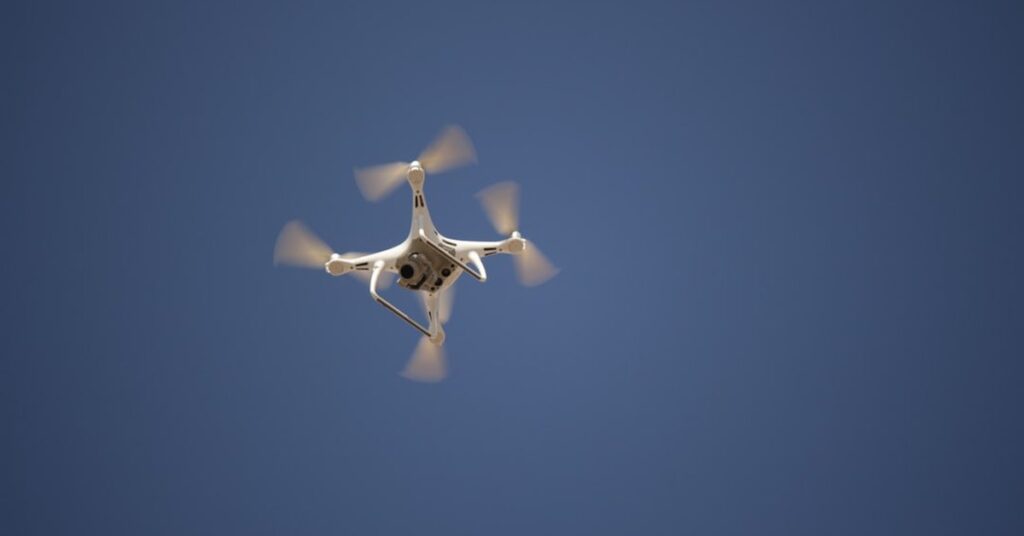
In February 2026, SpaceX and xAI joined a secretive Pentagon competition with a $100 million prize: build autonomous drone swarm technology that can translate voice commands into digital instructions for coordinated drone operations. The contest — reported by Bloomberg and Reuters — selected a small group of competitors for a six-month race to develop the most advanced swarming capability ever demonstrated.
The fact that Elon Musk's companies are competing in a drone swarm contest tells you everything you need to know about where the defense industry is heading. But the $100 million contest is not the story. It is a signal of a much larger market transformation — one where the software controlling drones matters infinitely more than the drones themselves.
Drones are cheap. Drone swarm software is the weapon.
In January 2026, Swiss-American company Auterion demonstrated what it calls the world's first live-fire combat drone swarm: a single operator engaging three targets simultaneously with drones from different manufacturers, coordinated through a single software platform.
The demonstration, conducted on a Florida military range, used Auterion's Nemyx platform — the software layer that turns autonomous drones from different makers into a single, coordinated combat force. In a separate test in December 2025, Auterion demonstrated a multi-manufacturer swarm strike — drones built by entirely different companies, operating as one, through shared software.
The significance cannot be overstated. As Auterion stated: "A small unit equipped with swarm-enabled systems can now halt mechanized formations that once required air support."
The key insight is architectural: the hardware is interchangeable. Different drone manufacturers, different airframes, different flight controllers — all unified by a single software platform. Nemyx is not a drone. It is the operating system that makes any drone part of a swarm. This is the pattern that will define military drone capability for the foreseeable future.
The Pentagon's drone swarm contest raises the bar further. The requirements — as reported by Bloomberg and Reuters — demand voice-to-swarm command translation, where an operator speaks a tactical instruction and the software converts it into coordinated maneuvers for multiple autonomous drones. The system must employ advanced swarming technology so drones operate as a coherent swarm rather than as individually controlled vehicles. Autonomous decision-making is essential — the swarm must adapt to changing conditions without continuous human input. And multi-domain awareness means the system must understand terrain, threats, and objectives in real time.
This is not remote-controlled aviation. This is natural language processing + autonomous navigation + real-time coordination + AI-driven decision-making — fused into a single platform that a soldier can direct with voice commands.
SpaceX and xAI bring AI and communication infrastructure expertise. But the competition is also a validation that the Pentagon believes no single existing system is adequate — it is investing $100 million to find something better than what exists today.
La oss bygge noe ekstraordinært sammen.
Stol på Lasting Dynamics for enestående programvarekvalitet.
While the US invests in swarm contests, Europe is building its own autonomous drone capabilities through EU-funded programs.
On February 26, 2026, the European Commission highlighted the ALTISS program — funded by the European Defence Fund — designed to move beyond the traditional "one drone, one operator" model.
ALTISS targets autonomous swarm missions for intelligence, surveillance, and reconnaissance (ISR). The program fills a capability gap between small 25kg mini-drones and large MALE (Medium Altitude, Long Endurance) platforms. Multiple drones operating as a coordinated swarm can cover large areas with persistent surveillance — a capability that would require significantly more expensive manned aircraft or satellites.
The European Defence Fund financing is strategically important: it establishes that autonomous drone swarm capability is a European priority, not just a US one. European companies developing swarm software for ALTISS are building for a European defense market, with European governance and European data sovereignty.
Europe's swarm ambitions extend below the surface. SABUVIS II, managed by the European Defence Agency with a €3.7 million budget, has completed trials of coordinated underwater drone swarms.
Led by Poland with Germany, Portugal, Latvia, and Estonia participating, the project created not just a collection of underwater vehicles but a coordinated swarm — autonomous platforms that communicate, coordinate, and execute missions collectively without continuous human control.
The naval implications are significant. Underwater drone swarms can conduct mine detection, submarine tracking, port security, and environmental monitoring across areas that would require far more expensive manned vessels. The Brussels Times reported the project as "shaping future naval missions."
The software challenge for underwater swarms is in many ways harder than for aerial swarms: limited communication bandwidth (acoustic rather than radio), GPS-denied navigation, complex three-dimensional movement, and hostile operating environments. The coordination algorithms must be more resilient and more autonomous because the communication link is less reliable.
A collection of drones flying in the same area is not a swarm. A swarm is a software-defined collective where individual vehicles operate as components of a unified system. The software that enables this includes:
Fra idé til lansering lager vi skalerbar programvare som er skreddersydd til dine forretningsbehov.
Samarbeid med oss for å akselerere veksten din.
The mathematical models that determine how individual drones interact — maintaining formation, distributing tasks, avoiding collisions, adapting to losses. These algorithms draw from fields including multi-agent systems theory, distributed computing, game theory, bio-inspired computing such as flocking behavior and ant colony optimization, and reinforcement learning for adaptive swarm behavior.
Swarms must communicate — with each other and with operators — in contested electromagnetic environments where adversaries are actively jamming, spoofing, and intercepting. Communication protocols for military swarms must be resilient to jamming and interference, low-latency for coordination, low-bandwidth since many drones share limited spectrum, self-healing when individual nodes are lost, and encrypted against interception.
In a swarm, decisions must be distributed. A centralized control model — where every drone reports to a central computer that issues instructions — creates a single point of failure and doesn't scale. Instead, each drone must make local decisions based on its own sensor data, information shared by neighboring drones, overall mission objectives broadcast by the operator, and rules of engagement embedded in its software.
This is edge AI in its most demanding form: real-time inference on resource-constrained hardware in a contested environment.
Every advance in drone capability drives demand for counter-drone capability. In February 2026, the US Army detailed its plans for AI-powered counter-drone systems, including Fortem's DroneHunter — an AI-driven net-capture drone that autonomously detects, tracks, and intercepts hostile drones.
Counter-drone systems are equally software-intensive. AI-powered detection identifies drones against complex backgrounds using radar, acoustic, electro-optical, and RF signature analysis. Tracking maintains a persistent lock on small, fast, maneuvering targets. Classification distinguishes between friendly, neutral, and hostile drones. Engagement selects and executes the appropriate response — whether jamming, kinetic, net capture, or directed energy. And swarm defense is perhaps the most demanding challenge: defeating coordinated drone swarms requires automated, AI-driven responses because human operators cannot manually track and engage dozens of simultaneous targets.
The competition is worldwide:
USA: Pentagon's $100M swarm contest, Auterion's live-fire demo, Fortem's counter-drone AI, extensive DARPA programs for autonomous systems.
Europa: ALTISS (EU-funded swarm ISR), SABUVIS II (underwater swarms), Helsing/Stark (€540M German drone contracts), Auterion/Airlogix German-Ukrainian joint venture for NATO drone production.
Vi designer og bygger digitale produkter av høy kvalitet som skiller seg ut.
Pålitelighet, ytelse og innovasjon i alle ledd.
Middle East: SIRBAI unveiled AI-powered autonomous drone swarm technology at UMEX 2026 — the first from the region, signaling rapid capability development.
Ukraine/Russia: Both sides deploying drone swarms in combat, generating the largest real-world dataset on drone warfare in history. Ukraine's drone forces executed 7,000+ ground robot missions in January 2026 alone.
The swarm intelligence market is projected to reach $7.23 billion by 2032, growing at a 41.2% CAGR — one of the fastest-growing defense technology segments. This growth is driven entirely by software: the algorithms, platforms, and AI systems that make swarms possible.
The drone software market is not a future opportunity. It is a current one, with contracts being awarded, programs being launched, and technology being demonstrated at live-fire ranges.
For software companies considering this market, the requirements span multiple disciplines:
AI and machine learning — target identification, path planning, swarm behavior optimization, counter-drone detection. ML models that run efficiently on edge hardware with limited compute resources.
Real-time systems — latency-critical processing for navigation, collision avoidance, and coordination. Software that fails gracefully rather than catastrophically when communication is degraded.
Communication protocols — resilient, low-bandwidth, encrypted communication for contested environments. Mesh networking that adapts to node losses.
Integration platforms — software that unifies different hardware platforms (Auterion's Nemyx model). Multi-manufacturer interoperability is explicitly what the military is demanding.
User interfaces — voice-to-command interfaces (Pentagon contest requirement), intuitive swarm control for non-specialist operators, real-time situational awareness displays.
Edge computing — AI inference on drones with limited power, weight, and processing capacity. Optimization for embedded systems.
Companies like Lasting Dynamics, with expertise spanning AI/ML, real-time systems, mobile applications, and integration platforms — and with European roots aligned with EU defense programs like ALTISS and SABUVIS II — bring exactly the combination of capabilities the drone software market demands.
The hardware is a commodity. The software is the weapon. And the race to build the best drone software is on.
Lasting Dynamics builds AI-powered, real-time software systems for mission-critical environments. To discuss how our capabilities apply to autonomous drone and counter-drone systems, contact our team.
Internal Links:
- Software Development for the Defense Industry: The Complete Guide
- The Machine War: How Ukraine's Robot Army Is Rewriting Autonomous Warfare
- AI Goes to War: Pentagon vs Anthropic and the Future of Military AI Software
- C4ISR Software: The Nervous System of Modern Defense
Forvandle dristige ideer til kraftfulle applikasjoner.
La oss skape programvare som gjør en forskjell sammen.

Michele Cimmino
Jeg tror på hardt arbeid og daglig engasjement som den eneste måten å oppnå resultater på. Jeg føler en uforklarlig dragning mot kvalitet, og når det gjelder programvare, er det denne motivasjonen som gjør at jeg og teamet mitt har et sterkt grep om smidig praksis og kontinuerlige prosessevalueringer. Jeg har en sterk konkurranseinnstilling til alt jeg tar fatt på - på den måten at jeg ikke slutter å jobbe før jeg har nådd toppen, og når jeg først er der, begynner jeg å jobbe for å beholde posisjonen.
