

打造卓越软件
让我们一起创造非凡。
Lasting Dynamics 提供无与伦比的软件质量。
Michele Cimmino
5 月 29, 2026 • 15 min read

Legacy system modernization decisions follow the 6R framework (retire, retain, rehost, replatform, refactor, rebuild). For a critical regulated application expect €400k-€1.2M and 12-24 months; for a core banking or insurance rebuild €4M-€25M+ over 24-48 months with parallel dual-run. Replatform is the most under-used and often the right first move. Big-bang rebuilds without staged strangler-fig cutover are the #1 cause of programme failure.
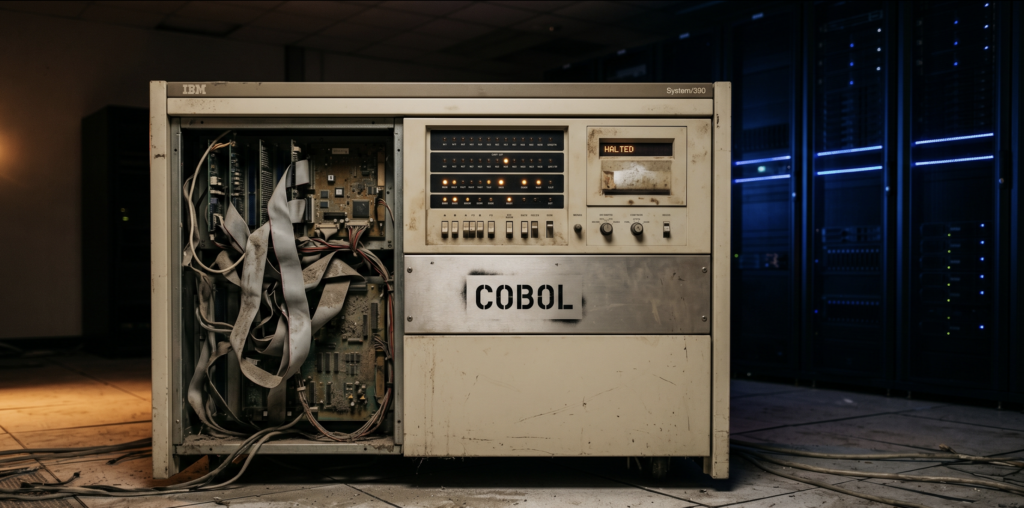
A bank we worked with last year had a core lending engine written in COBOL in 1996. It ran on a mainframe leased from a vendor that no longer trains engineers on the hardware. Every change request waited four months. Every audit cost a fortune. The board had been talking about "modernizing" it for nine years.
That is the real shape of legacy system modernization in 2026. It is not a slide deck about "digital transformation." It is the calculation of how to replace systems that are still making money, still under regulatory scrutiny, and still understood by perhaps three people on the planet - without taking the business offline.
This guide is written for the CTOs, VPs of Engineering, and IT Directors who actually have to make that call. It covers the 6R framework, real cost ranges, the patterns we use for mainframe modernization, COBOL modernization和 monolith to microservices migrations, and the operational guardrails required in regulated sectors. There are no platitudes about "embracing change." Just the engineering.
Already scoping a modernization programme? Skip ahead to the 12-month roadmap, 或 book a modernization assessment.
Legacy system modernization is the structured process of upgrading aging software systems - typically mainframe applications, monolithic codebases, or end-of-life platforms - to modern architectures, runtimes, and operating models. It uses frameworks such as the 6R (retire, retain, rehost, replatform, refactor, rebuild) to classify each application and apply the lowest-risk path to a modern, maintainable, compliant stack.
A single non-critical application replatform typically takes 6-12 months. A critical application refactor in a regulated context takes 12-24 months. A full core system rebuild for banking or insurance takes 24-48 months, including 6-18 months of parallel dual-run reconciliation before cutover. Programmes that attempt a big-bang migration of an entire estate routinely slip by 18+ months.
The strongest argument for legacy system modernization - or, viewed at a per-system level, legacy application modernization - is not technical debt. It is the opportunity cost of carrying systems that block every other initiative.
Across our engagements in banking and insurance, the recurring symptoms look almost identical:
When we model the five-year total cost of ownership of a "do nothing" path versus a structured legacy application modernization path, the do-nothing scenario is almost never cheaper after year three. The exception is a system already on a clear retirement path - which is a strategy, not an accident.
You will see the "5 R's of application modernization" cited everywhere. The framework was popularised by Gartner's original five Rs and expanded to six by AWS's well-known migration taxonomy. For real enterprise portfolios, the more useful version has six decisions, and the sixth, retain, is often the one that prevents the most unnecessary cost and risk.
| R | What it means | When it fits | Typical effort |
|---|---|---|---|
| Retire | Decommission the system entirely; absorb its function into nothing or another system. | Functionality is no longer used or duplicates another system. | Low (data archival only) |
| Retain | Keep as-is on its current platform; reassess in 12–24 months. | Stable, low-change system with no compliance pressure; modernization ROI is negative. | 极简 |
| Rehost | Lift-and-shift to a new infrastructure (e.g. mainframe to cloud) without code change. | You need to exit a data centre or hardware contract fast; functionality is acceptable. | Low-Medium |
| Replatform | Move to a new runtime with minimal code changes (e.g. WebSphere → Spring Boot on Kubernetes). | Architecture is acceptable but the platform is end-of-life or expensive. | 中 |
| Refactor | Restructure the codebase without changing external behaviour; introduce modularity, tests, observability. | Codebase is salvageable but tangled; you need agility before deeper change. | Medium-High |
| Rebuild / Replace | Re-implement from scratch (rebuild) or swap for a commercial product (replace). | Existing system cannot support new business model; or a strong SaaS option exists. | 高 |
The 6R framework is not a sequence. It is a portfolio decision. A serious modernization programme classifies every application in the estate - typically 80 to 400 of them in mid-sized financial groups - and applies a different R to each. Treating the whole estate as a single rebuild is the single most common reason these programmes fail.
让我们一起创造非凡。
Lasting Dynamics 提供无与伦比的软件质量。
The 5 R's of application modernization are rehost, replatform, refactor, rebuild 和 replace. Most modern engineering teams add a sixth - retire - and many add a seventh, retain. The full 6R or 7R framework allows you to make different decisions for different applications instead of forcing a single strategy across the entire estate.
There is no honest one-line answer, but there are honest ranges. After running modernization for banks, insurers and healthcare providers, the cost drivers we see most often are:
Rough order-of-magnitude figures we use as starting points for legacy application modernization budgets in Europe:
| Scope | Typical 12-month range (EUR) |
|---|---|
| Single non-critical application replatform | €120k - €400k |
| Critical application refactor (regulated context) | €400k - €1.2M |
| Mainframe workload rehost (per ~500k LOC bundle) | €800k – €2.5M |
| Core system rebuild (banking/insurance core) | €4M – €25M+ over 24–48 months |
In practice, legacy modernization pricing should be estimated only after discovery, because the real cost depends on code volume, data complexity, integration surface area, compliance requirements, operating model and the length of the dual-run period. These are programme costs. The avoided cost of legacy maintenance, hardware leases, vendor licensing and audit overhead usually offsets 35–60% of the modernization spend over five years.
Legacy system modernization in Europe typically ranges from €120k-€400k for a single non-critical application replatform, €400k-€1.2M for a critical application refactor in a regulated context, €800k-€2.5M per ~500k LOC bundle for mainframe rehost, and €4M-€25M+ over 24-48 months for a core system rebuild in banking or insurance. The avoided cost of legacy maintenance, hardware leases, vendor licensing and audit overhead usually offsets 35-60% of that programme spend over five years.
The three big-spend options are where most teams get stuck. Here is the decision logic we use.
In practice, the decision is rarely about choosing the most modern option. It is about choosing the lowest-risk intervention that removes the current bottleneck without creating a larger delivery problem.
Replatforming moves an application to a new runtime - for example from a mainframe to a containerised Java service - with minimal changes to the application code. Refactoring keeps the runtime but restructures the code itself: extracting modules, introducing tests, removing dead code, improving the data model. Replatforming changes where the code runs; refactoring changes how the code is organised.
Replatform is the most under-used option. Many CTOs jump from "this is painful" to "we must rebuild" because rebuild sounds more transformational. Replatform is often the responsible first move that buys 18 months of breathing room while a rebuild is properly scoped.
从创意到发布,我们根据您的业务需求量身打造可扩展的软件。
与我们合作,加速您的成长。
Mainframe modernization sits in its own category. The systems are decades old, the hardware is on multi-year leases, and the engineers who built them are largely retired. Search interest in COBOL modernization spiked roughly 6x in early 2026 - from a ~210/month baseline to ~1,300 in February (DataForSEO / Google Keyword Planner) - as a wave of large European and US institutions hit end-of-contract decision points.
There is no universal pattern, but four COBOL modernization migration paths cover the majority of real programmes:
Tools like Micro Focus, OpenFrame, or Heirloom translate or emulate the runtime so COBOL workloads execute on Linux. This is the highest-cost and lowest-risk path, and often the only sensible option for safety-critical financial cores.
Convert COBOL to Java, C#, or Go using static analysis tools. Effective for batch-oriented workloads with limited interactivity. Output is mechanical and needs human-driven refactoring before it becomes maintainable.
Build a new service layer around the mainframe, route new traffic to it, gradually move endpoints. The mainframe shrinks over years rather than being replaced in one move.
Build a new system on a modern stack, run both systems in parallel for 6-18 months, reconcile every transaction. This is the highest-cost and lowest-risk path, and often the only sensible option for safety-critical financial cores.
The choice between these mainframe modernization paths is driven less by technology and more by appetite for risk and the regulator's tolerance for a cutover window. In practice, most successful COBOL modernization programmes combine two of them - usually strangler fig plus targeted greenfield replacement of the highest-risk components.
Replacing a legacy system is worth it when the cost of keeping it - including maintenance, talent risk, vendor lock-in, compliance overhead and missed product opportunities - exceeds the cost of replacement within a five-year horizon. For most production-critical systems older than 15 years and serving regulated industries, that condition is already true. The harder question is whether to replace it now or stabilise it first through replatforming or refactoring.
A monolith to microservices migration is its own modernization pattern, and it is the one most often done badly. We have seen teams turn a working monolith into 47 microservices that share the same database, the same release cycle and the same on-call rotation - paying every cost of distributed systems for none of the benefits.
我们设计并打造脱颖而出的高品质数字产品。
每一步都可靠、高效、创新。
We use a small set of rules:
For the mainframe to cloud migration sub-class of this work, microservices are rarely the right initial target. A well-structured modular monolith on Kubernetes, with clear API boundaries, is the realistic first stop - then targeted extraction where the business case justifies it.
This is where most generic modernization advice falls apart. In banking, insurance, healthcare and other regulated sectors, modernization is not just engineering - it is engineering inside a compliance perimeter that has opinions about every step.
Specific patterns we run:
For any system that processes money, claims, prescriptions, or clinical decisions, the new system runs in shadow mode alongside the old one. Every transaction is processed by both; differences are reconciled and investigated until the difference rate is below the agreed threshold. Cutover happens only then.
Every architectural decision, every test result, every cutover step is documented as evidence. DORA, PCI DSS 4, HIPAA and GDPR auditors will all want this. Capturing it during the work is dramatically cheaper than reconstructing it afterward.
Modern systems are expected to show where every piece of data came from, who touched it, and how it was transformed. Legacy systems usually cannot. This must be designed in from day one of any rebuild.
Under DORA in particular, software vendors serving EU financial institutions are expected to run threat-led penetration testing and document resilience scenarios. Build the testing infrastructure as part of the modernization, not as an afterthought.
Every dependency - open-source library, SaaS service, hosted database - needs SBOM-level documentation and a contingency plan.
For deeper context on the regulatory frame, see our coverage of digital transformation in banking 和 金融服务云. In healthcare, the equivalent regulatory anchor is the HL7 FHIR standard - see our FHIR integration guide for how interoperability mandates shape healthcare modernization.
Modernizing a regulated system? We run modernization in banking, insurance and healthcare under ISO 9001 and PCI DSS 4. Book a 30-minute assessment call →
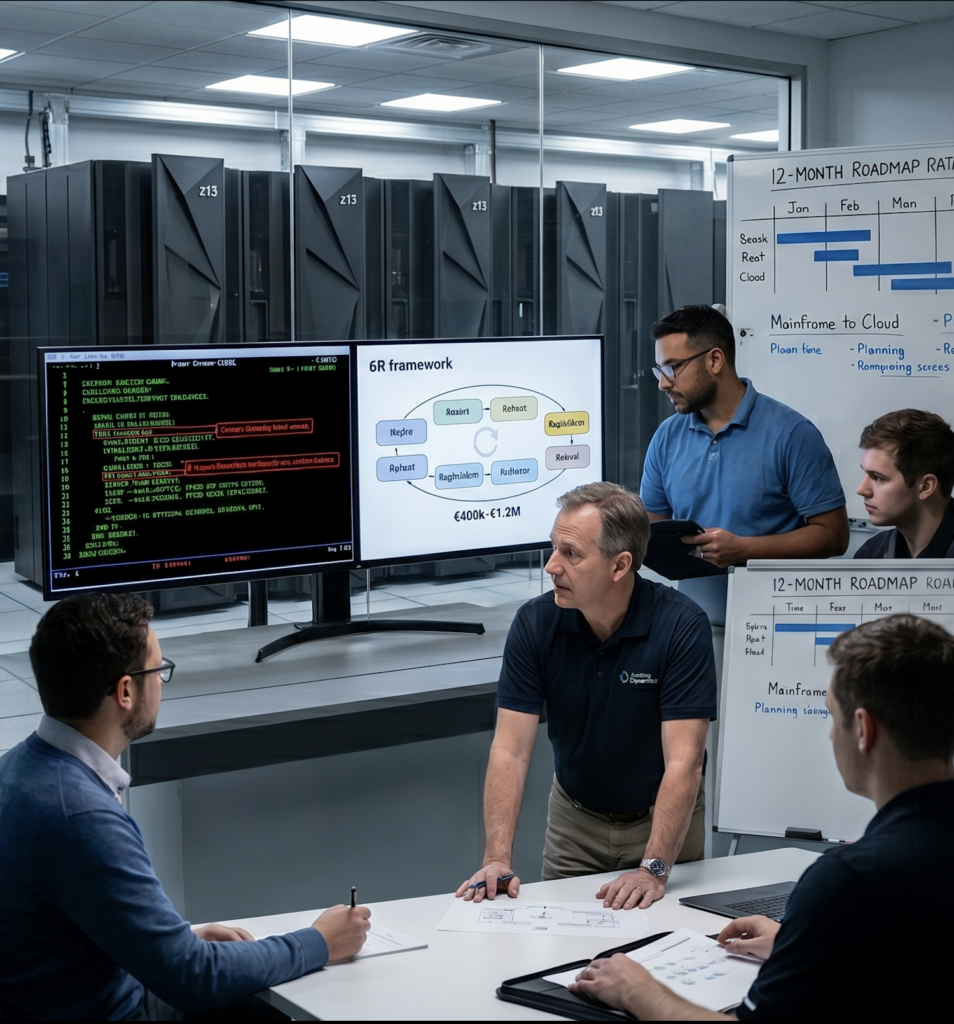
For a critical application - say, a mid-sized core lending or policy administration system - this is the shape of a credible 12-month programme.
Months 1–2: Discovery. Static code analysis, dependency mapping, integration inventory, data profiling, regulatory mapping. For a mainframe to cloud migration this phase also includes workload profiling and a candidate target landing zone. Output: a 6R classification for every component and a target architecture document.
Months 2–3: Architecture and test scaffolding. Define the target stack, deployment model, observability and security baseline. Stand up CI/CD. Build a regression test corpus from production traffic.
Months 3–6: Strangle the first slice. Pick the smallest, lowest-risk slice of functionality. Build the new implementation. Wire it behind a feature flag. Dual-run.
Months 6–9: Expand and reconcile. Migrate the next 2–4 slices. Continue dual-run reconciliation. Begin sunset planning for the components being retired.
Months 9–12: Cutover and stabilise. Move full traffic to the new system. Keep the legacy in read-only mode for the agreed retention window. Capture lessons. Plan the next 12 months.
This is the structure of a programme that can realistically reach cutover. Programmes that try to migrate everything in a single big-bang typically slip by 18+ months and lose executive sponsorship before they reach cutover.
We are an engineering team, not a strategy consultancy. Our legacy system modernization services are built around three things that matter more than any framework:
If you are weighing a legacy system modernization 或 legacy application modernization decision - whether that is a single replatform, a mainframe-to-cloud move, or a multi-year core rebuild - start with an assessment. We will look at your estate, classify it against the 6R framework, and give you a realistic budget and timeline. If the answer is "retain for 24 more months and reassess," we will tell you that too.
Ready to scope your legacy system modernization? Get a legacy system modernization assessment →
This article was written by Michele Cimmino, CEO Lasting Dynamics - an EU-based custom software development company that has run legacy system modernization programmes for banks, insurers, healthcare providers and public-sector clients since 2014. We are ISO 9001 and PCI DSS 4 certified and hold operational presence across Italy, Switzerland and the wider EU. Frameworks referenced in this piece (6R, strangler fig, replatform/refactor/rebuild) are industry-standard taxonomies; the cost ranges and roadmap reflect our own engagement data, not vendor benchmarks.
The 5 R's of application modernization are rehost, replatform, refactor, rebuild and replace. Most modern engineering teams add a sixth - retire - and many add a seventh, retain. The full 6R or 7R framework allows you to make different decisions for different applications instead of forcing a single strategy across the entire estate.
Replatforming moves an application to a new runtime - for example from a mainframe to a containerised Java service - with minimal changes to the application code. Refactoring keeps the runtime but restructures the code itself: extracting modules, introducing tests, removing dead code, improving the data model. Replatforming changes where the code runs; refactoring changes how the code is organised.
Replacing a legacy system is worth it when the cost of keeping it - including maintenance, talent risk, vendor lock-in, compliance overhead and missed product opportunities - exceeds the cost of replacement within a five-year horizon. For most production-critical systems older than 15 years and serving regulated industries, that condition is already true. The harder question is whether to replace it now or stabilise it first through replatforming or refactoring.
There is no honest one-line answer, but there are credible ranges. In Europe, a single non-critical application replatform typically lands between €120k and €400k over 12 months. A critical application refactor in a regulated context runs €400k to €1.2M. A mainframe workload rehost is usually €800k to €2.5M per ~500k lines-of-code bundle. A full core system rebuild in banking or insurance is €4M to €25M+ spread over 24-48 months. The avoided cost of legacy maintenance, hardware leases, vendor licensing and audit overhead offsets 35%-60% of the modernization spend over five years, which is why the 'do nothing' path is almost never cheaper after year three.
Four paths cover the majority of real mainframe and COBOL modernization programmes. (1) Emulation on x86 or cloud using tools like Micro Focus, OpenFrame or Heirloom - the cheapest path, removes the hardware dependency but not the language problem. (2) Automated transpilation of COBOL to Java, C# or Go, effective for batch workloads, but the output is mechanical and needs human refactoring before it becomes maintainable. (3) Strangler fig migration, build a new service layer around the mainframe and gradually move endpoints; the mainframe shrinks over years instead of being replaced in one move. (4) Greenfield replacement with parallel run - build a new system on a modern stack, run both in parallel for 6–18 months, reconcile every transaction; highest cost, lowest risk, the only sensible path for safety-critical financial cores.
Decompose a monolith only along bounded contexts (account onboarding, payments, claims, scheduling), never along technical layers or per-table. The acid test is independent deployability: if two services cannot be deployed independently, they are one service. Database splitting alone often takes 30–50% of total programme effort, so any monolith with a single shared database is not ready for microservices until the data is partitioned. Day-one requirements include distributed tracing, structured logs, contract testing and circuit breakers, adding them later is significantly more expensive. In 2026 the trend is back toward modular monoliths with two or three extracted services rather than swarms of microservices that share a database, a release cycle and an on-call rotation.
Start with replatform when the business logic still serves the business, the pain is concentrated in the runtime (cost, scalability, end-of-life support), and you need a result in 9–15 months. Move to refactor when the logic is correct but the codebase has become unsafe to change and you need automated tests, observability and API boundaries before any further work - budget 12–24 months. Commit to rebuild only when the product roadmap requires capabilities the current architecture genuinely cannot support (real-time data, AI features, event-driven workflows, multi-tenant SaaS), the current vendor is no longer viable, and leadership has appetite for a 24–48 month dual-run programme. Replatform is the most under-used option; many CTOs jump from 'this is painful' to 'we must rebuild' when replatform is the responsible first move that buys 18 months while a rebuild is properly scoped.
For a critical application - for example a mid-sized core lending or policy administration system - a credible programme runs about 12 months and follows a fixed shape. Months 1–2 are discovery: static code analysis, dependency mapping, integration inventory, data profiling and a 6R classification for every component. Months 2–3 stand up the target architecture, CI/CD and a regression test corpus built from production traffic. Months 3–6 strangle the first low-risk slice behind a feature flag with dual-run reconciliation. Months 6–9 expand to the next 2–4 slices and begin sunset planning for retired components. Months 9–12 cut over full traffic, keep the legacy in read-only mode for the retention window and plan the next 12 months. Programmes that attempt a single big-bang migration typically slip by 18+ months and lose executive sponsorship before cutover.
将大胆的想法转化为强大的应用。
让我们一起创造出具有影响力的软件。

Michele Cimmino
我相信努力工作和每日承诺是取得成果的唯一途径。我对质量有一种莫名其妙的吸引力,当涉及到软件时,这就是让我和我的团队对敏捷实践和持续的过程评估有强烈把握的动力。我对任何事情都有强烈的竞争态度--我不会停止工作,直到我达到顶峰,一旦我达到顶峰,我就开始工作以保持这个位置。
